
In this four-part series, we present municipal policies and projects that offer inspiration and illuminate potential pathways for more sustainable and equitable futures. While each example represents a modest step on its own, together they suggest how municipalities take an active role in building local resilience while taking collective responsibility. These examples arose from our research in two case study cities, Freiburg (Germany) and Grenoble (France), and cover various sectors: waste management, food, housing and advertising in public spaces. They demonstrate innovative, but also contested ways in which municipalities navigate local development and structural pressures, including fiscal constraints and pressures for economic growth. The fourth and last story examines the implementation of a municipal ban on advertising in Grenoble and its legal implications across various scales.
A low hanging fruit
The French municipality of Grenoble is known as one of the first cities to ban commercial advertisements from its streets. In 2015, 326 billboards were withdrawn from the public space as the result of a policy led by the left-green political alliance under Mayor Eric Piolle. The desire to remove commercial advertisements from public spaces was already part of a campaign by the left-green political alliance “Grenoble, Une Ville pour Tous” in 2014. Shortly after taking office, the new council faced an important decision: its contract with the multinational outdoor advertising company JCDecaux was due to expire at the end of 2014, and negotiations were underway over its possible renewal. True to its campaign promises, the municipal majority ultimately decided not to renew the contract, using this opportunity to remove advertising from 2,000 m2 of public space. The billboards were then replaced with trees, 300 “free-expression” boards for citizens, and further urban furniture for institutional advertising, such as information on local initiatives and events.
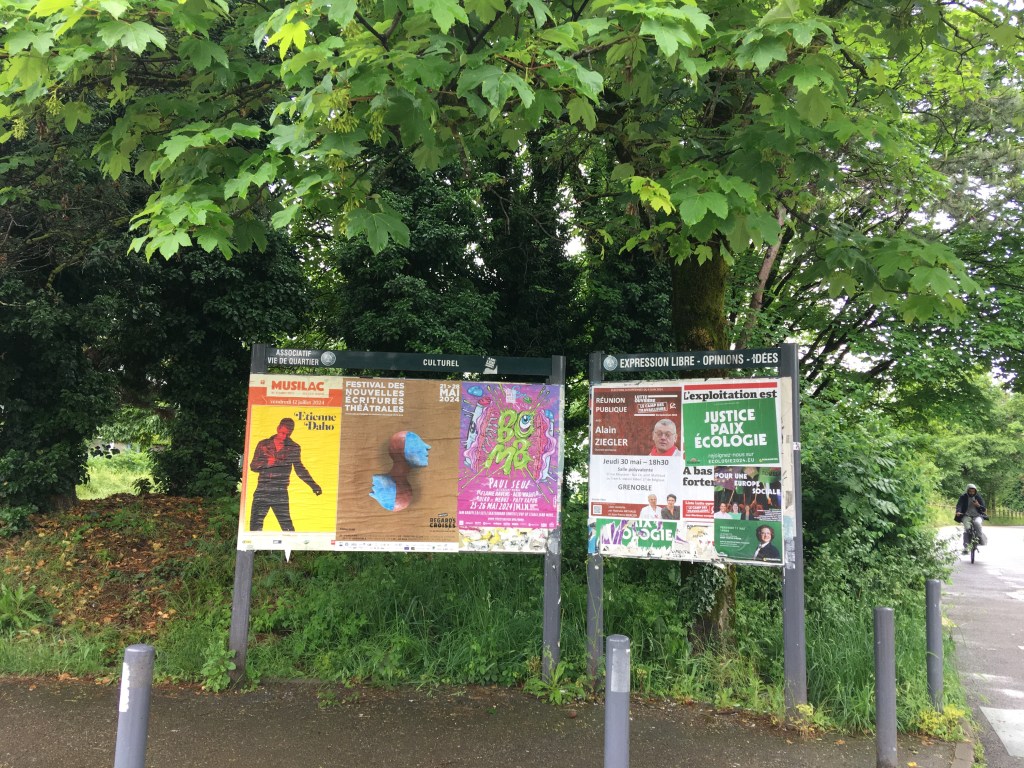
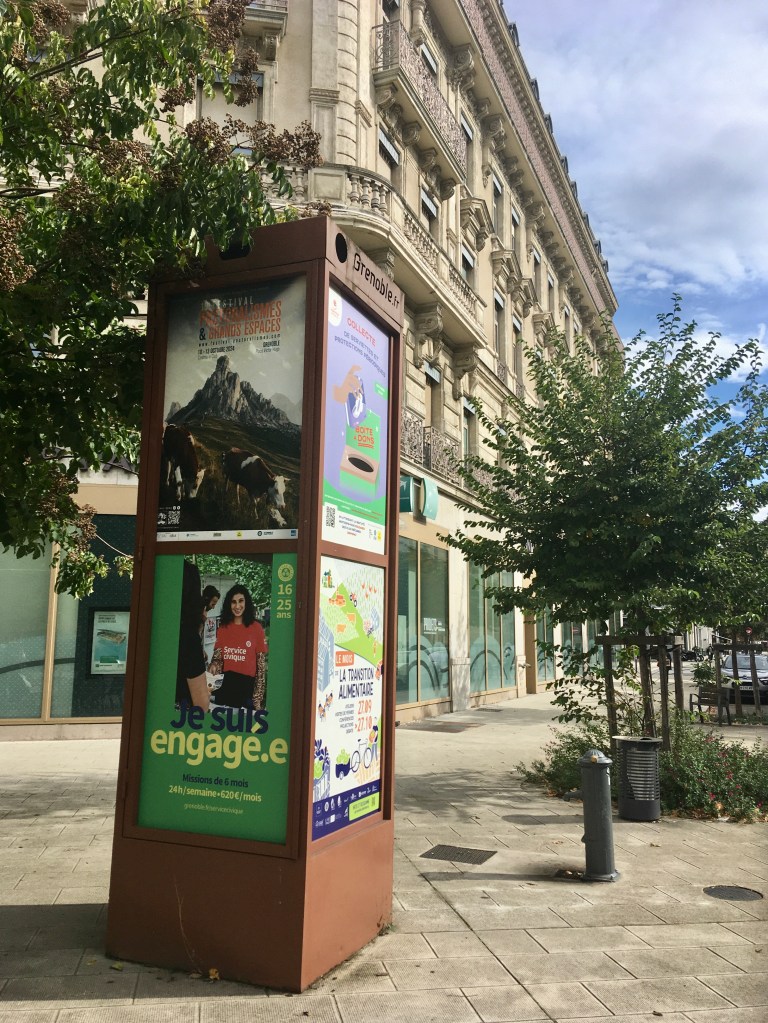
“Free-expression” boards (left) and institutional advertisements managed by the municipality (right) in the streets of Grenoble, © Coline Chardon
Beyond the symbolic act of replacing some of billboards with trees, the political dimension of public space was central to the elected representatives’ motivations, as Gilles Namur (councillor in charge of public spaces, mobility and biodiversity) explained: “We are committed to giving the people in Grenoble a chance to breathe again, to give them back their public spaces and the views of the mountains that surround us, so that these spaces are no longer dominated by commercial and consumerist interests”1. For the municipality, this decision marked the beginning of significant urban improvements to the city, such as the development of citizen expression, the allocation of more space to nature, the promotion of local businesses and the protection of young generations2. It considered former policy to be old-fashioned (car-orientated and consumption-driven), and sought to create a human-scale city, with a sense of community and slower mobility.
A snowball effect within the Métropole
Further steps have been taken at the metropolitan level. In 2015, the wider urban area of Grenoble changed its legal status and became a metropolitan authority by law. This shift was accompanied by the requirement to develop new urban planning documents applicable to all 49 municipalities in the area. The Métropole thus became the institution responsible for planning documents related to advertising regulations. Pursuing its policy of “combating advertising”, the City of Grenoble was firmly determined to adapt its local advertising regulation, a responsibility which now fell to the metropolitan authority.
In 2018, the Métropole therefore began the process of creating a metropolitan local advertising regulation, the “Règlement Local de Publicité intercommunal” (abbrev. RLPi), a document covering all the municipalities in the region, based on the ambitious goals of its “central city”, Grenoble. The RLPi is a local adaptation of the national regulation on advertisement. In France, local authorities can adapt the regulations to their specific context in many ways and regarding several aspects: the types of ads allowed, their size or location, the density of signs, as well as energy-saving or light pollution measures. The RLPi of Grenoble-Alpes Métropole was officially approved in February 2020 after two years of development and consultation.
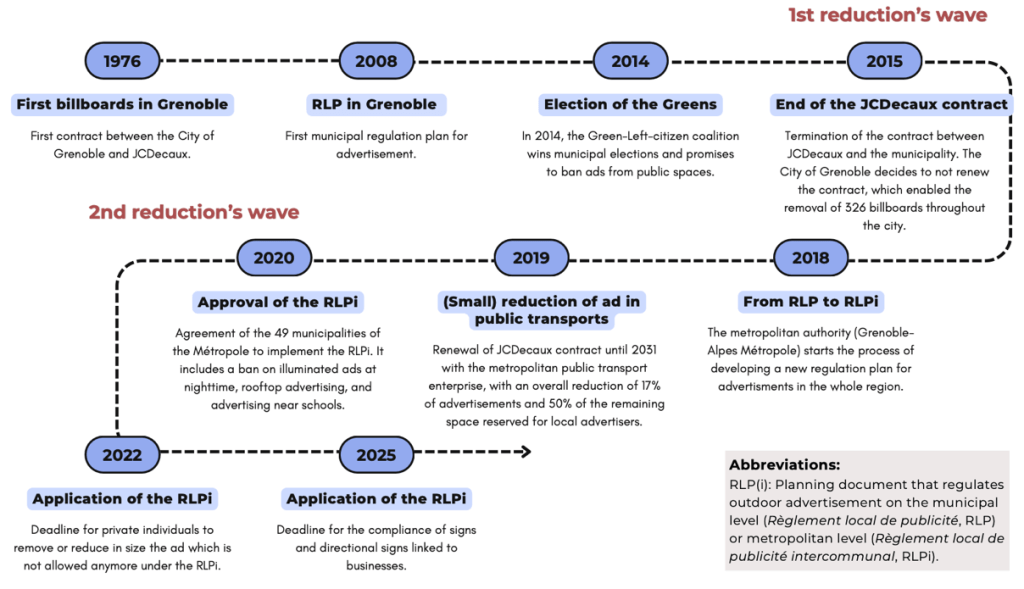
Chronology of the reduction of advertisements in Grenoble, © Coline Chardon
Following the end of JCDecaux’s contract (first reduction’s wave) and the adoption of the RLPi (second reduction’s wave), advertising is banned in 90% of Grenoble’s territory3, confining advertisements to commercial, industrial and heavy-traffic zones. However, advertising billboards remain present at the bus and tram stops. This is due to the fact that the local public transport union, the SMMAG, renewed its contract with JCDecaux until 2031 (this amounts to 1,000 billboards according to activist group Extinction Rebellion). However, the number of billboards is set to be continuously reduced, while there will be an increase in spaces for culture, mobility, and for associations. Furthermore, 50% of advertisements are reserved for local commerce. Since June 1st, 2023, all illuminated billboards located at public transport stations have to be switched off between 1am and 6am, in line with energy-saving goals set by the city’s sufficiency strategy as well as national policy.
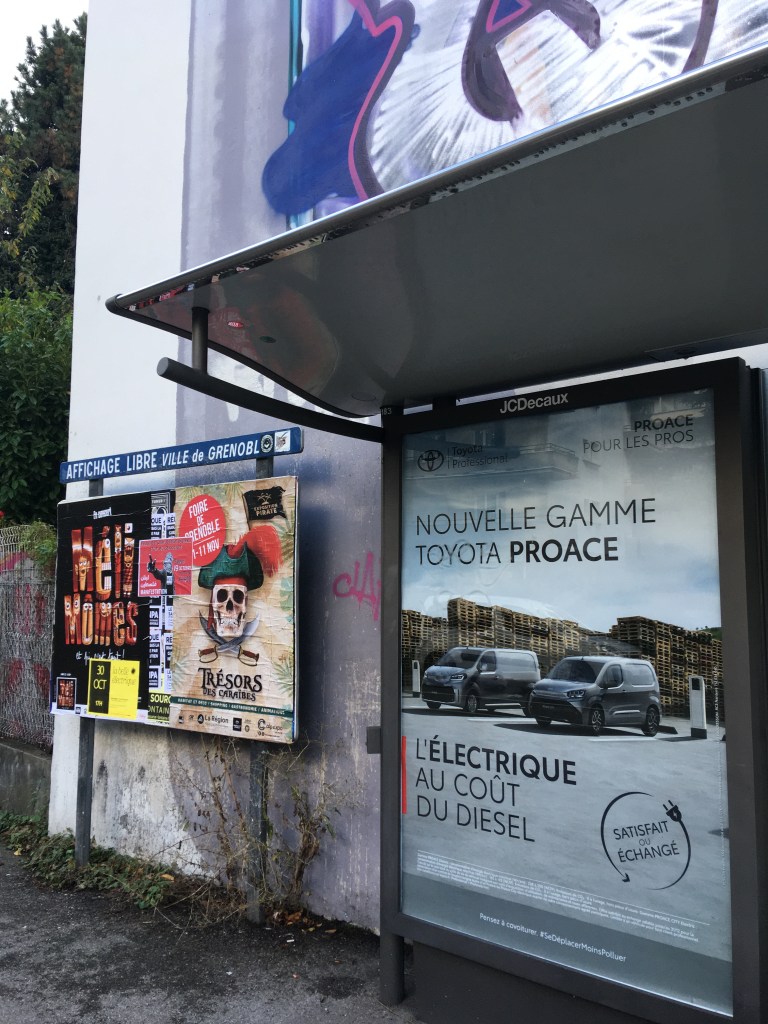
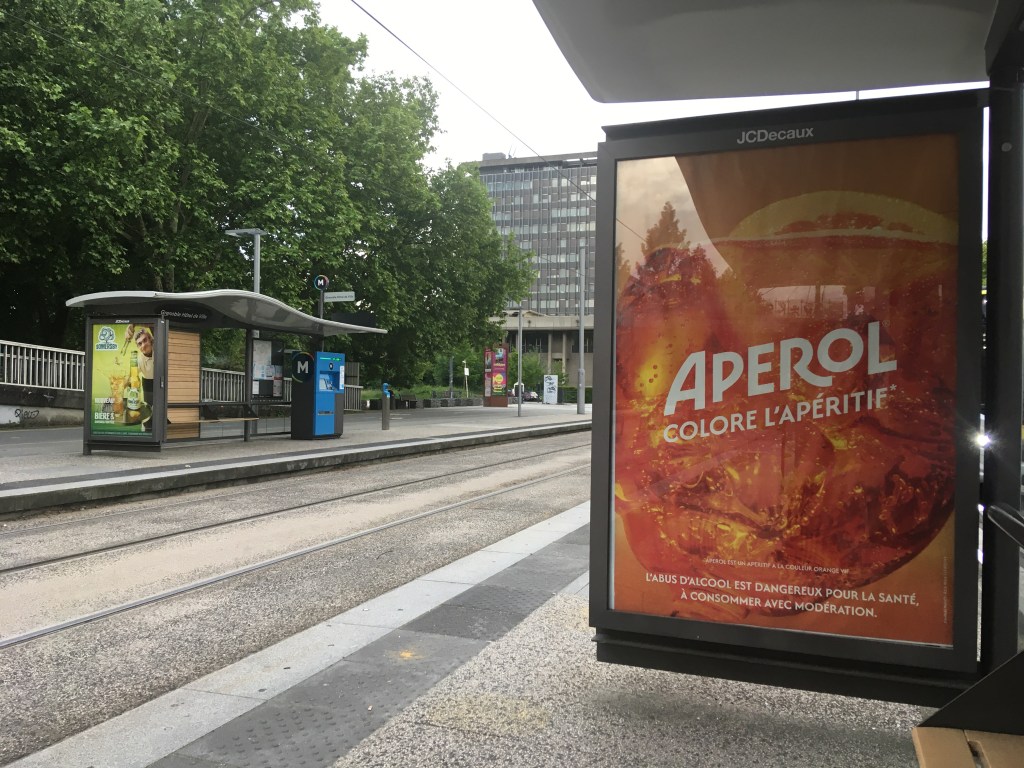
Public expression board versus advertisement board at a bus stop (left), ad for alcoholic beverages at a tramway station (right), © Coline Chardon.
A financial burden for municipalities?
One of the main arguments against removing advertising billboards from public spaces is financial, as many municipalities are reluctant to give up a source of revenue. In Grenoble’s case, however, this financial loss needs to be put into perspective: according to the municipality, renewing the contract with JCDecaux would in any case have generated far lower revenues than with the previous one. While the former contract had reportedly brought in around €600,000 per year over ten years, estimates for a new one ranged between only €100,000 and €150,000 per year annually. Even at the upper bound, the loss remains well below 0,5% of the municipal budget. This loss was partly offset by significant savings in other areas of municipal spending, including a 25% reduction in elected representatives’ allowances, lower protocols costs (entertainment expenses for official visits, events etc.), and reduced costs linked to the municipal vehicle fleet.
The question of financing is more critical for the local transport enterprise, which has decided to extend its contracts with JCDecaux until 2031. The SMMAG argues that is it strongly dependent on advertising revenues to finance the maintenance of its transport infrastructure (representing €500,000 per year). Therefore, commercial ads are still visible in the streets of Grenoble and neighbouring towns at the bus stops and tram stations.
Hope and backlash
Grenoble is not the only city to implement ad bans, and several others such as Lyon and Nantes have followed. Beyond the French border, São Paulo had already paved the way years earlier with the introduction of the Clean City Law in 2007, which labelled outdoor advertisements as a form of “visual pollution”4. Following in these footsteps, Amsterdam has recently initiated stricter controls on advertising content, while Berlin and Hamburg have attempted public referendums on a ban5. However, the moves to restrict advertisements in public spaces have encountered backlash in several places. In several French municipalities, planning documents were declared invalid by the administrative courts, due to lawsuits filed by the advertisers.
And there are further legal limits to the regulation of advertisements. Indeed, due to constitutional principles such as freedom of speech, freedom to do business, and the right to fair competition, advertising can never be completely banned, only restricted. Content can be controlled, but not everywhere. A metropolitan agent explained: “When someone puts up an advertisement on their own property (private land), there’s nothing we can say about it. We can’t control it or even demand that it conveys a particular message. That said, the law does set out some basic guidelines. We’re not allowed to advertise cigarettes, for example.”
Another challenge is the implementation and control of regulations. In France, a new policy shifted the responsibility for these regulations from the departmental level to the individual mayors. Not only are there around 35,000 mayors who must be informed of current measures, but they are also already engaged in many other tasks and may be unable to handle this responsibility on top. Many voices from civil society but also local authorities have stressed that it is difficult for municipalities to control the implementation of the regulations due to limited staff capacity, the complexity of the regulations, and political commitments.
Thinking cities beyond advertising revenues
Cities are key sites for production and consumption, partly fuelled by advertising campaigns. At the same time, they also represent promising arenas for sustainable transformation. The case of Grenoble shows a way to tackle (over)consumption through an institutionalised approach, rather than focusing on individual behaviour or responsibility. Outdoor advertising captures attention in an unavoidable way and influences behaviours, whether people are aware of it or not. Moreover, billboards are disproportionately concentrated in the most deprived and polluted neighbourhoods, compounding existing spatial inequalities. Meanwhile, the revenues generated by advertising overwhelmingly flow to private companies, not the communities that bear its costs. In this context, calls for individual responsibilization alone are insufficient; structural responses are needed to address deeply rooted structural injustices.
Local authorities do have the capacity to reverse these trends by restricting the implementation of billboards in specific areas, reducing the size of ads, controlling their content, regulating nighttime illumination, or, as in Grenoble, by ending contracts with advertising companies such as JCDecaux. Relying on a source of income tied to profits that depend on continuous economic growth should not be considered as a sustainable model, and so the financing and maintenance of local public infrastructure too. Local institutions can choose to balance their budgets differently and redefine priorities. In Grenoble, both political motivations – rooted in the idea of public space as a common to be preserved against commercial interests – and the pragmatic use of a window of opportunity enabled a long-lasting reduction in outdoor advertising.
Footnotes
1 Original citation here: https://www.grenobleencommun.fr/3-questions-sur-la-fin-de-la-pub-en-ville-a-grenoble/ (accessed on 11/09/2024)
2 https://www.grenoble.fr/uploads/Externe/41/6_746_DP_pub.pdf (accessed on 12/09/2024)
3 https://www.grenobleencommun.fr/90-du-territoire-sans-publicite-a-grenoble-avec-le-rlpi/ (accessed on 11/09/2024)
4 https://www.theguardian.com/cities/2015/aug/11/can-cities-kick-ads-ban-urban-billboards (accessed 12/05/2026).
5 https://www.postwachstum.de/werbung-als-katalysator-der-wachstumskrise-20260317 (accessed 12/05/2026).

