
In this four-part series, we present municipal policies and projects that offer inspiration and illuminate potential pathways for more sustainable and equitable futures. While each example represents a modest step on its own, together they suggest how municipalities take an active role in building local resilience while taking collective responsibility. These examples arose from our research in two case study cities, Freiburg (Germany) and Grenoble (France), and cover various sectors: waste management, food, housing and advertising in public spaces. They demonstrate innovative—but also contested—ways in which municipalities navigate local development and structural pressures, including fiscal constraints and pressures for economic growth.
In this second blog post, we focus on an initiative in Grenoble that experiments with food democracy in an attempt to establish a right to food for all.
Spearheaded by a group of local organizations and funded by the municipality, the project, recently named DALLE (Droit à l’alimentation Locale et Équitable), consists of a common fund to which some residents of Grenoble contribute. In exchange, they receive between 100 and 200 euros (depending on the size of the household) to spend at a list of accredited solidarity or organic grocery stores, farmers’ markets, and restaurants. Together, this group of residents is also tasked to decide on different parameters of the fund, including how and towards what kind of food their allocation can be spent. The fund was officially launched in June 2025 with an initial group of 60 residents.1 The image below shows a simplified diagram of how the SSA fund works in Grenoble.
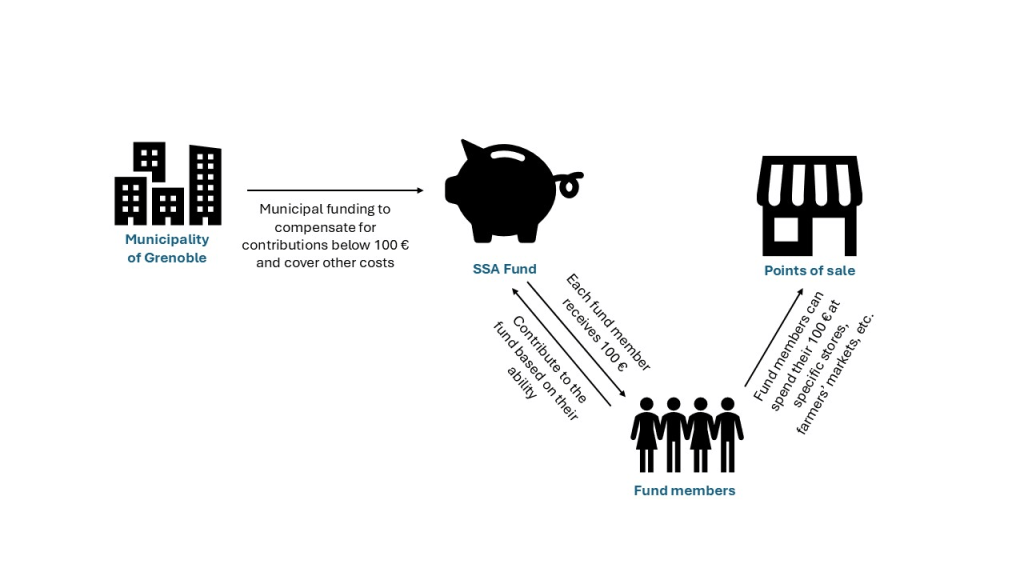
The experiment in Grenoble is rooted in the principles of the Sécurité sociale de l’alimentation (social security for food), or SSA, which is an idea, turned movement, that has been gaining traction in the last few years in France. It is a response to the failures of the dominant food system ranging from high greenhouse gas emissions to food precarity and poor working conditions for agricultural workers. Inspired by the history of the French social security system (or la Sécu), which was once constituted of funds largely managed by workers, the SSA has been conceptualized as a macroeconomic lever that could transform the food system through the creation of funds democratically managed by citizens and financed by a social contribution.2 In its full form, all citizens would contribute to these funds according to their ability and, as a result, gain the right to access food produced in a way that is chosen democratically. Indeed, the members of the funds would decide on criteria such as local origin or organic production that would then be reflected in agreements between the fund and producers.
Although it has since been transformed through a number of reforms, the French social security system first enabled the development of a healthcare system that was directed, at least in part, by the workers who were contributing to the Sécufunds rather than being subjected to the imperatives of the capitalist economy.3 The group of organizations that developed the idea for the SSA advances that the SSA funds could be the basis for developing such a production for the food system. Indeed, the SSA could set the ground for a food system – from production to distribution – that is dictated by the needs and values of the population rather than profitability.
A Municipality’s Approach to Transforming the Food System
Currently, the principles laid out by the SSA are being experimented with by local initiatives such as the one in Grenoble. Like most SSA initiatives, the SSA fund in Grenoble is managed by a group of civil society actors, including nonprofit organizations working in the food and solidarity sectors, a health mutual, and cooperatives. However, the initiative is unique in the active role that the municipality of Grenoble has taken in its elaboration. In 2023, the City of Grenoble announced its intention to financially support a local SSA fund as part of a new measure called the bouclier social et climatique (social and climate shield), which was created within the framework of a 25% increase in the local property tax. This tax increase was voted on by the City Council in a context of high inflation and decreasing revenues for municipalities. Given the abolition of the residence tax in 2023 and that French municipalities cannot create new taxes, one elected official characterized the local property tax as the “last fiscal lever” available to municipalities in France. Next to investing in infrastructure projects and serving to face inflation, the additional revenue generated by the tax is funding measures in the sectors of housing, mobility, food, and health/social emancipation—together forming the bouclier social et climatique. One of these measures is the support for a local SSA initiative, as it was outlined in a resolution passed on February 5th, 2024. For the first phase of the project, which extended from June 2025 to the end of the same year, the City’s funding amounted to 229 472 euros.4
The SSA initiative is also inscribed in the City’s local food strategy, which aims to establish the right to good quality food for all its residents. It is from this angle that the City can act on food-related issues, even though food production does not typically fall under the jurisdiction of municipalities. Importantly, they benefit from the clause générale de compétence (general clause of competence), which means that they can intervene on matters that pertain to a ‘local public interest’ as long as they are not already under the exclusive jurisdiction of the state or other levels of government5. By leveraging this responsibility toward the local public interest, in this case, the right to food of Grenoble’s residents, the City of Grenoble could then explain offering an important financial support to the SSA fund.
Institutional Support and Potential Drawbacks
To support the development of the SSA fund, the City of Grenoble not only provided funds but also took on a coordinating role by putting together a stakeholder assembly and working groups, which were tasked to reflect and make proposals on different aspects of building an SSA fund. Through this collaborative process, different ideas were discussed, and some disagreements arose. Among other things, there was a disagreement on how the money from the fund should be redirected to food producers. While one group of actors wanted to prioritize alleviating food precarity by establishing a fund that could be operational as soon as possible, others emphasized the importance of investing in transforming production and moving away from treating food as a commodity. Although these goals are not irreconcilable and, on the contrary, even work together, they operate on a different timeline. Given that the funding of the municipality also works with shorter deadlines, it is the prior vision that was favoured. Furthermore, the fund is, for now, limited in what kind of agreements it can have with food producers since the money provided by the municipality needs to directly benefit residents of Grenoble. Thus, the fund could not invest in transforming the production of a farmer who is located outside of the jurisdiction of the city.
Instituting A Local Post-Growth Food System?
The institutional support provided by the municipality catalyzed the emergence of an SSA initiative in Grenoble, nurturing the development of a local food system that is guided by democratic principles rather than by growth-oriented objectives. However, it also steered the project in a certain direction, revealing contradictions regarding the extent to which municipalities can foster the transformation of the food system. Indeed, the involvement of local governments in alternative projects can risk subjugating them to other constraints, such as political deadlines, which could force these initiatives to lose some of their radicality.
This blog post is based on the master thesis of Marilou Binder, who carried an empirical fieldwork on the SSA in Spring 2025 in Grenoble.
1 https://www.grenoble.fr/1059-securite-sociale-de-l-alimentation.htm#par6648
2 https://securite-sociale-alimentation.org/la-ssa/a-propos-de-la-securite-sociale-de-lalimentation/
3 Da Silva, N. (2022). La Bataille de la Sécu. La fabrique éditions.
4 https://oyez-media-grenoble.fr/document-le-texte-adopte-par-le-conseil-municipal/
5 Verpeaux, M., & Rimbault, C. (2024). Les collectivités territoriales et la décentralisation. La Documentation française. pp.124-125.
 MUTUAL