3–4 November 2025 | College for Social Sciences and Humanities I Essen
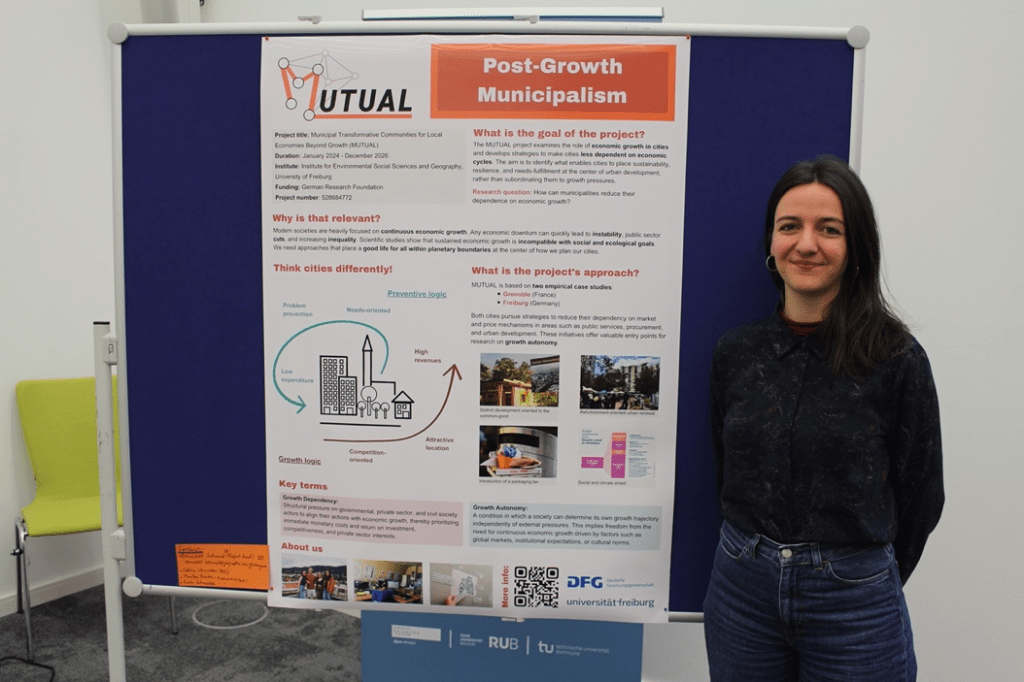
Last November, Coline participated in a two-day workshop organized by the Global Sustainability Governance research group at the College for Social Sciences and Humanities in Essen. The aim of the workshop was to foster exchange on the multi-level dimensions of growth (in)dependencies and their various facets within an academic setting. Researchers from various disciplines and countries shared their perspectives and current work on ‘growth dependency’, post-growth, and economies beyond GDP. Contributions covered dimensions as diverse as the UN level, welfare states, European policies, local implications, and the role of individual mindsets. The variety of these approaches reflects the deep-rooted belief that economic growth is both a means and an imperative for maintaining the functions of systems across every scale. Coline presented MUTUALS’s work on municipal struggles and responses during the round table on research and practice on growth (in)dependencies as well as through a poster presentation. By presenting some mechanisms of local dependencies on economic growth (such as through taxation structures or the financing of public infrastructure), she highlighted how municipalities are trapped within structural hurdles, but also how they trace alternative pathways (e.g. via the raise of the property tax to finance ecological and social projects).
“We have an implementation gap, not a data gap!”: During the exchanges, the major challenge of translating and implementing post-growth ideals within European institutions or national states became particularly evident, highlighting the need to investigate further how these dependencies can be overcome in practice. Questions surrounding the democratic implementation of degrowth or post-growth policies should be emphasized in future research, for example by examining proposals such as the introduction of new taxes (e.g. wealth tax or carbon tax). Here too, it appears that research at the local level could make a significant contribution. As a strategic entry point for observing socio-ecological transformations, this focus allows us to better understand the legal, economic, and political levers of local states, while taking into account the cultural and relational aspects of interactions between institutions and civil society.
Thank you to the organizers for the invitation and the thoughts-provoking exchanges!
Click here to view the MUTUAL poster that Coline presented in Essen.
 MUTUAL