

This summer, we travelled more than 7,600 kilometres by train and bus to attend various conferences in Oslo, Birmingham and Vienna. These were amazing opportunities to meet our peers, find new inspirations, and share our research.
The first stop was Coline’s attendance of the 18th Conference of the International Society for Ecological Economics (ISEE) and 11th International Degrowth Conference in Oslo. This was Coline’s first time participating in the ISEE-Degrowth Conference, and she was both amazed and overwhelmed by the programme (40 parallel sessions scheduled at each time slot!). This size of the event testifies to the growing interest in the degrowth movement and ecological economics perspectives among academics and practitioners.
One of Coline highlights was the session on radical planning, which discussed translating degrowth into spatial practice and reflected on the roles of planners. The discussion echoed her experience working with the municipality of Grenoble, where city planners often sought to defer political responsibility for their work to elected officials or legal frameworks. In contrast, the panellists called for more “activist planners” to escape this supposedly “neutral” space and to integrate both citizens and politicians equally in decision-making. The session also highlighted how spatial, temporal, and sectoral gaps remain unaddressed within mainstream urban planning, which continues to advocate area-based projects, short-term interventions, and siloed approaches. This raises the question of how to prioritise what already exists, emphasising the need to engage local communities to adapt and reuse spaces rather than defaulting to new construction. Why should planning always transform, demolish or add – why not preserve, reuse, or just do less? Perhaps the most radical act resides in resisting the urge to intervene and creating space for more democratic and long-term planning.
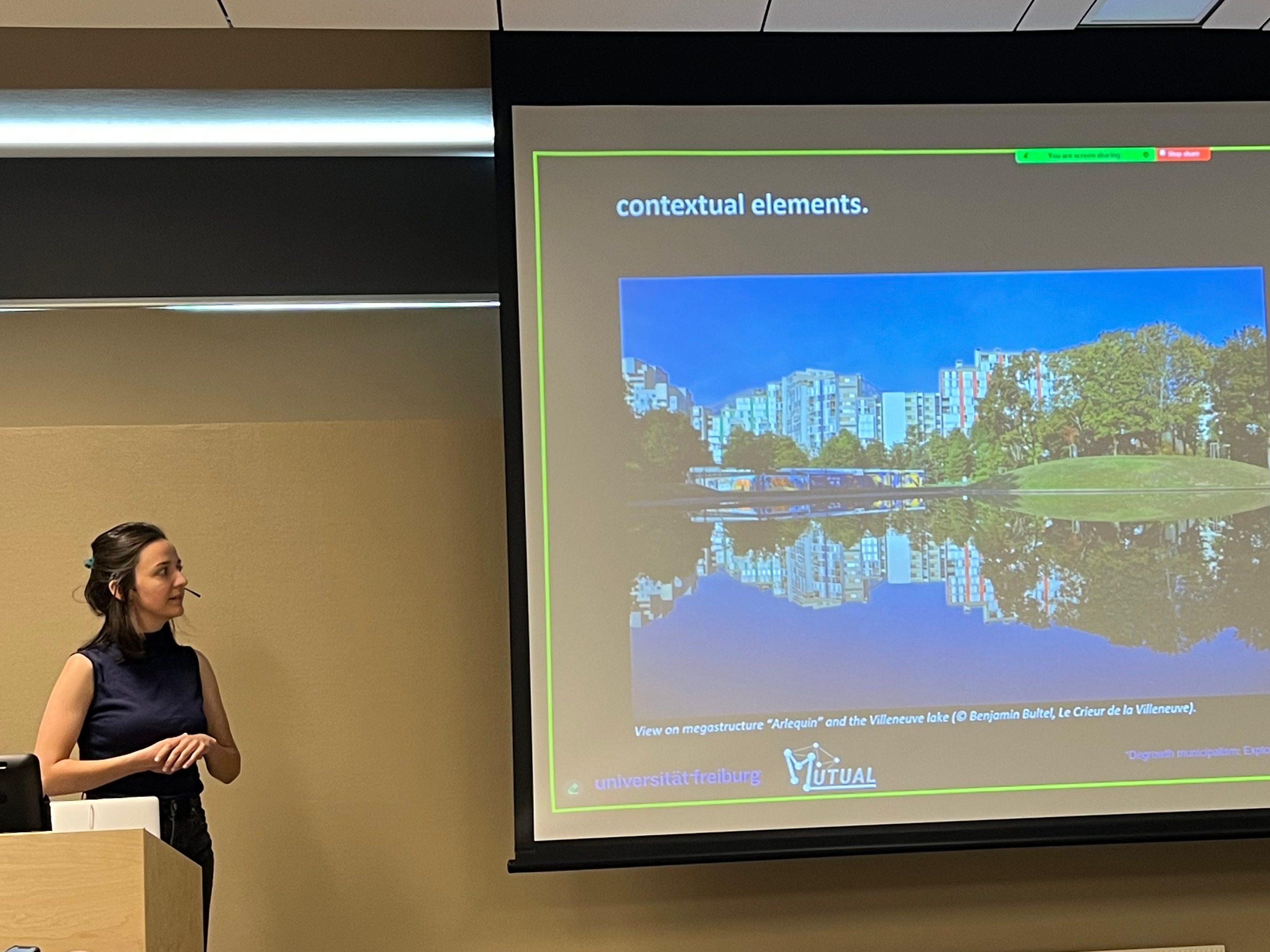
These reflections resonated even more when Coline presented her own work on planning alternatives in Grenoble (called: “Taking care of what exists”) during the session on degrowth municipalism. The MUTUAL project takes the municipal scale as an entry point for observing relations and practices that differ from incumbent, growth-based forms of planning. Overall, many inspiring and thought-provoking examples were shared from across Europe, addressing questions related to the democratisation of alternative practices, the tensions between reformist and transformative logics, and the analysis of planning systems to better “hack” them and inspire new legal arguments that go beyond growth imperatives. Invited by session organisers, a Catalan elected representative co-moderated the session and called for a stronger, more comprehensive framework to implement postgrowth– an explicit demand to bridge theory to praxis.
🔗 See detailed info on the “Degrowth municipalism” session here.
🔗 Further reflections on the overall conference can be found here.
The second stop was Coline’s attendance of the RGS-IBG Annual International Conference (26–29 August 2025). Hosted by the University of Birmingham, this year’s conference was organised around the theme ‘Geographies of Creativity/Creative Geography’. The programme invited participants to consider how creative practices can shape research, but also how creativity supports activism and fosters decolonial and postcapitalist futures. In her opening address, Prof. Patricia Noxolo also warned against the use of creativity and related terms when they are co-opted for neoliberal exploitation and destruction. She referred to what Harvey, among others, has called “creative destruction”: for example, the process of destroying the old to make way for the new, especially through the demolitions of housing in low-income neighbourhoods and its replacement with attractive dwellings for wealthier residents. But what can replace this creative destruction? One pathway is the creative reuse of dismissed buildings for community purposes.
Coline’s contribution in the session “New and Emerging Urban Geographies of Care” revolved around the renovation case of a public swimming-pool in a working-class neighbourhood of Grenoble. Out of service for many years and threatened with demolition, the pool was given a second life thanks to the mobilisation of citizens and the creation of a collective that reclaimed the place for community wellbeing and care activities. The session offered a great opportunity to delve deeper into the flourishing field of urban geographies of care, connecting with inspiring peers from around the world, and envisioning future collaboration.
🔗 See the intervention of the Chair of Conference, Professor Patricia Noxolo here.
Third was Ben’s attendance at the EUGEO Conference (8–11 September 2025). Hosted in Vienna, a central European location, the conference set out to explore the “Geographies of a Changing Europe.” In recent years, escalating crises have produced increasingly worrisome conditions that are not only described through variously prefixed terms like climate crisis or social crisis but are now discussed in aggregate as a polycrisis. It is these grand-scale challenges that lead scholars to ask equally grand-scale questions: How are the ways we think about humanity and planet Earth imbricated with our understandings of space, knowledge, and responsibility? In her reflections on the planetary turn, Judith Migglebrink explored what this means for human geography—suggesting that it foregrounds the complex, entangled spatio-temporalities and deep relationalities that characterize humanity’s existence on our planet.
Accordingly, the session “Spatio-temporal infrastructures and policies for a just post-growth transformation” addressed these big questions while exploring how they connect to the everyday and the mundane. Testifying to the growing attention to spatial perspectives of post-growth, an inspiring set of contributions traced the spatio-temporal situatedness of post-growth practices and ideas without losing sight of broader structural changes. A shared focus on the concrete but often hidden and inconspicuous powerfully demonstrated that post-growth transformations are not merely abstract shifts but concrete processes that emanate from and touch upon our everyday lives—as citizens, as consumers, as residents, as workers, as humans.
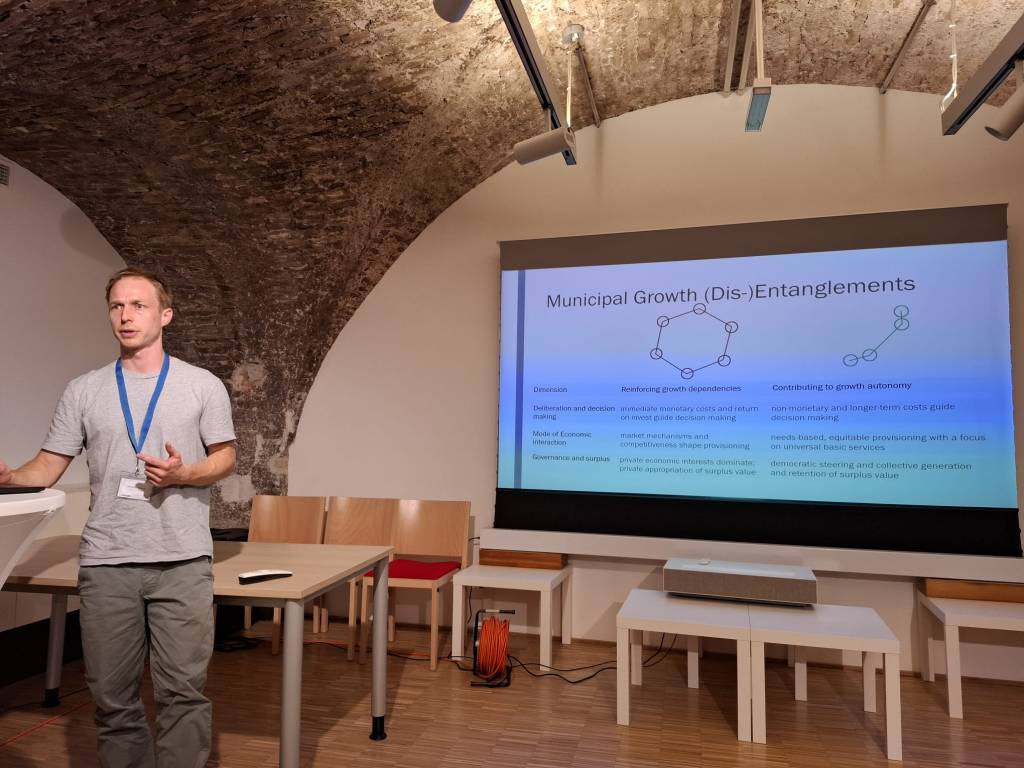
Ben’s presentation exemplified this grounded approach, tracing how changing the everyday practices and discourses in urban planning can serve as a starting point to tackle municipal growth dependencies. Using the example of Freiburg’s Kleineschholz development, he showed how the integration of alternative housing organizations such as the Miethäuser Syndikat and small cooperatives not only shifts the rationalities and goals of urban planning but also supports the decommodification of housing. While multiple ambiguous tendencies remain in place – above all the creation of new living spaces instead of the redistribution of existing housing – new relations emerge between city officials and housing organizations that point towards needs-based rather than profit-driven housing development.
 MUTUAL