In July, Matt Thompson (Bartlett School of Planning, University College London) visited the MUTUAL project team as a guest researcher. As a critical urban geographer, Matt researches alternative economies and postcapitalist transformations with a focus on place-based movements and the local state. He has been instrumental in shaping the discourse around “new” or “radical” municipalism – a movement aimed at the democratic (re-)appropriation of urban spaces through institutional strategies. His long-standing experience around municipalities and local alternative economies makes him a prime interlocutor for the MUTUAL team.
Matt’s week-long visit was filled with discussions, presentations, and field trips. In a series of exploratory workshops, we presented preliminary insights from the MUTUAL project and discussed conceptual and empirical issues and paths forward. Based on Matt’s rich theoretical and practical knowledge, we traced the diverse connections and potential synergies between post-growth and municipalism. These ranged from fundamental questions of the role of the state, the relation between agency and structure, and the longue durée of neoliberal capitalism, to specific observations around the logic of projectification and multi-level growth dependencies.
Several field trips to local housing and urban development projects – past and ongoing – provided tangible examples enriching our conceptual discussions. We started with the visit of the Grethergelände, an old industrial site close to Freiburg’s main station and founding location of the Miethäuser Syndikat. With support from Matthias Möller – long time housing activist with the Miethäusersyndikat and receiving a PhD on the historical trajectory of self-organized housing with a focus on the cooperative settlement “Freidorf” in Basel – we explored the historical and contemporary developments of self-organized housing and discussed overarching issues such as inclusivity, adaptation, institutional framework conditions, and the (changing) relations of housing projects and city officials. The field trip and discussions profited from the rich engagement of experts in Freiburg’s local housing landscape including Mona Haas (Dachgenossenschaft Wohnen für Alle eG und Pavillon für Alle e.V.); Helma Haselberger (Bauverein Wem gehört die Stadt e.V.miet and Mietshäuser Syndikat); Philipp George (Klimaschutz im Bundestag e.V.); and Philipp Späth (University of Freiburg and strongly involved in the Vauban development through the housing cooperative Genova).
Our second field trip led us to the ongoing district development project Kleineschholz. The pioneering project will comprise around 500 residential units exclusively developed by community-oriented builders rather than profit-driven investors. Through an open concept allocation process, approximately half of the plots were awarded to self-organized housing projects, including three projects from the Mietshäuser Syndikat and several housing cooperatives. While the project successfully demonstrates alternative approaches to municipal housing development through its innovative allocation process, it fell short of its original vision when the planned ground lease system (Erbbaurecht) failed due to financial constraints, forcing a shift to conventional property purchases.
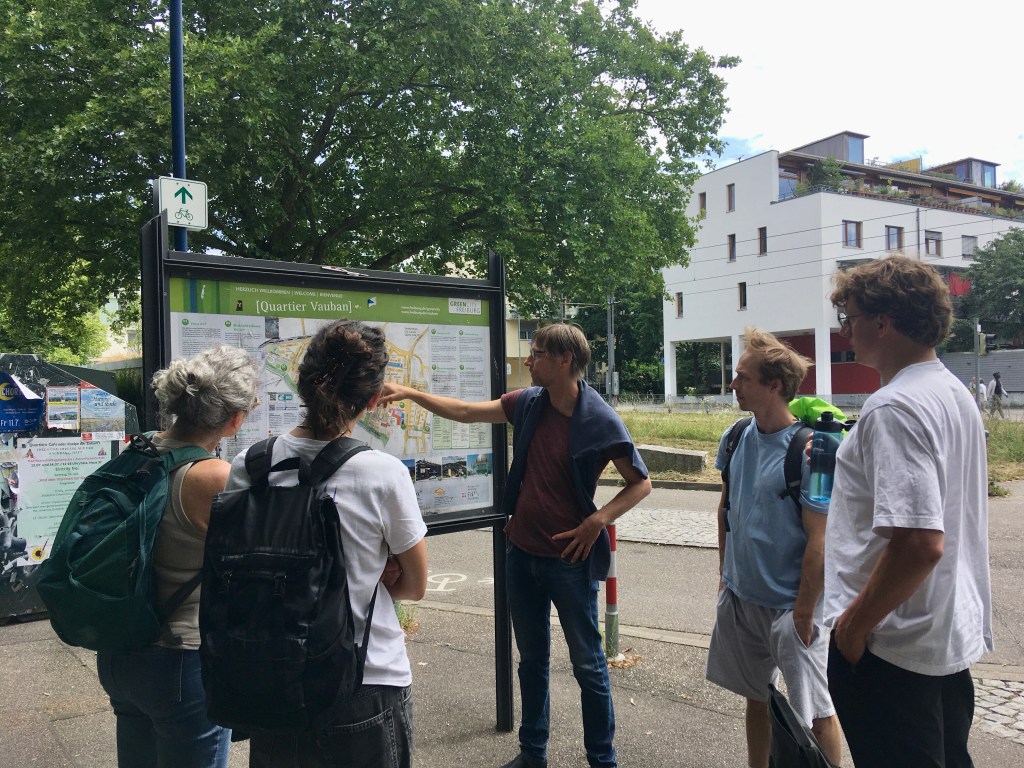
On our third and final field trip, Philipp Späth took us through the Freiburg district of Vauban. Built on the site of a former French military base, the internationally renowned district was conceived as a sustainable urban development. Philipp recounted the different ways the active local community constructed and defended this vision for the neighbourhood. Specifically, he presented the history of the Genova housing cooperative in which he has been involved since its onset. We learned about the opportunities and challenges that come with such a living arrangement, their experience with developing a flexible and sustainable housing design, as well as the struggles they face especially when it comes to making the cooperative as inclusive as possible.
Furthermore, on July 8th, Matt presented insights from his research on alternative economies and post-neoliberal strategies in Zagreb and Amsterdam as part of the EPICUR lecture series “Transformative Cities“. He discussed how alternative economic models, specifically foundational economy, doughnut economics and community wealth building, can be brought together to transform the policy strategies of municipalist-oriented cities (read more: here).
 MUTUAL